 Code Behavior Analysis
Ownership and Bus Factor
Understand who knows which parts of the code
Ownership and Bus Factor
The bus factor is one of those notorious rules in software engineering that sounds almost like a joke. It describes how many people on a team would need to be hit by a bus (or, more realistically, get sick, go on parental leave, or change jobs) before a project is in serious trouble.
I've worked on several projects where a single developer was the only person who truly understood critical parts of the system. When that person suddenly became unavailable(illness, a job change) the entire project was put at risk.
This is one of the main reasons I value pull requests and code reviews. Not primarily because they catch bugs, but because they spread knowledge. Knowledge silos, where one person exclusively owns critical code, are a major technical risk and often, a bit surprisingly, a cultural one as well.
I've seen how this can lead to unhealthy dynamics where individuals begin to feel indispensable and (un?)intentionally use that position to their advantage. I've even found myself in that situation, developing a false sense of importance. When I left my comfortable job in a mid-sized company and joined a new team in a large enterprise with lots of smart people, I got a much-needed reality check.
Why it matters
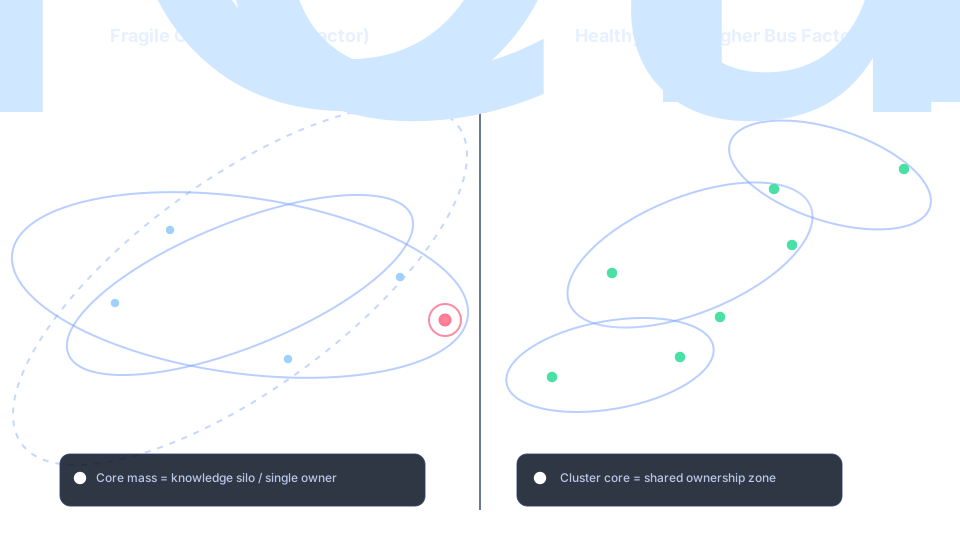
Ownership analysis shows who contributes to each part of your codebase. When one person owns 95% of the commits in a critical module, that's a knowledge silo and a major risk. If the bus factor is 1 or 2, you're vulnerable.
By mapping commits to authors, you can find these dangerous concentrations of knowledge. A healthy codebase has multiple people familiar with each important part, so no single departure cripples the team.
Cosmic Analogy
The visualization below shows two orbital systems representing different bus factor scenarios:
Cosmic analogy
How to Fix
Collaborative Development Practices
- Mandate code reviews for all changes to ensure at least two people understand each change. We can't avoid the situation when pull requests are not rubber stamps, but it's still better than nothing.
- Implement pair programming or mob programming sessions on critical, single-owner modules.
- Assign secondary owners to critical modules. It's usually people who regularly review and contribute to that area.
Knowledge Sharing & Documentation
- Create comprehensive documentation for high-risk, single-maintainer modules before knowledge is lost.
- Schedule knowledge-sharing sessions where sole owners present their modules to the team.
Team Rotation & Onboarding
- Rotate developers through different areas of the codebase to spread knowledge organically. That's good for product-oriented teams, but I'm not that sure about teams working on a project. These projects are usually more cost-sensitive.
- Use onboarding as an opportunity to transfer knowledge by pairing new hires with domain experts.
Culture & Ownership Mindset
- Encourage a collective ownership culture where team members feel empowered to work across boundaries.
Monitoring & Risk Management
- Set up bus factor alerts that trigger when any module drops below a 2-person threshold.
- Plan knowledge transfer activities before team members go on extended leave or transition roles.
Does this actually work?
I've been running this analysis against real repositories in Code Evolution, a personal side project, to see whether the idea actually makes sense in practice. It's still rough and unfinished, and for now it only uses a demo repository, but you can already check it out. I'm planning to open-source it soon.
See this one running