 Code Behavior Analysis
Lead Time and Change Velocity
Track delivery pace and workflow efficiency
Lead Time and Change Velocity
I've encountered my fair share of lead time issues over the course of my career. It often begins the same way: a quick refinement that underestimates the effort or overlooks critical dependencies.
Then we got stuck in the middle of the sprint, wondering which tasks will slip to the next sprint. The number of factors that can cause delays is staggering: unclear requirements, slow code reviews, understaffed DevOps teams (very, very common), or simply too many meetings.
There's no silver bullet for fixing lead time, but tracking it over time helps identify bottlenecks and evaluate whether process changes actually make a difference. That's why lead time became a core metric in the DORA performance model.
Why it matters
Velocity shows how fast your team ships code and lead time measures how long it takes from starting work to getting it merged. When velocity drops, something is slowing your team down. When the lead time is long, work sits waiting instead of moving forward. Fast velocity with short lead time means your team is productive and your process works well.
Cosmic Analogy
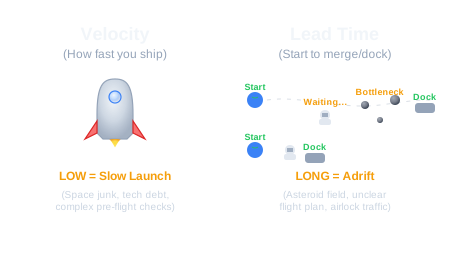
Velocity shows how strong the rocket engines are once they're firing. Small flames mean drag from things like extra checks, coordination overhead, or clutter slowing the ship down.
Lead time shows the full journey from Earth to docking: the drifting astronaut and asteroids represent waiting and bottlenecks along the way. A short, glowing path means a smooth flight with few delays. In simple terms, velocity is how fast you fly, while lead time is how long it takes to reach orbit and dock.
Cosmic analogy
How to Fix
Code Review & PR Management
- Set SLAs for code reviews to prevent PRs from being stuck for days without feedback.
- Break large features into smaller PRs to reduce review time and accelerate merge cycles.
Process & Workflow Optimization
- Identify and remove process bottlenecks. Analyze where work sits idle (reviews, deployments, testing).
- Implement work-in-progress limits to prevent too many parallel tasks that extend the lead time.
- Improve requirement clarity upfront to avoid mid-sprint surprises and delays.
Automation & Infrastructure
- Automate testing and deployment pipelines to eliminate manual delays and wait times.
- Address technical debt in areas that slow down development and extend lead times.
Developer Productivity
- Reduce context switching and meeting overhead that kills developer productivity and velocity.
Measurement & Monitoring
- Track lead time by feature type (bug fix vs. feature) to understand where delays concentrate.
- Monitor trends over time to validate whether process improvements actually reduce lead time and increase velocity.
Does this actually work?
I've been running this analysis against real repositories in Code Evolution, a personal side project, to see whether the idea actually makes sense in practice. It's still rough and unfinished, and for now it only uses a demo repository, but you can already check it out. I'm planning to open-source it soon.
See this one running