 Code Behavior Analysis
Developer Collaboration Graph
Visualize who commits to the same files and collaboration patterns
Developer Collaboration
I began my career at a company where engineers regularly moved between teams and projects. Team boundaries existed, but they were loosely defined, and project managers reassigned people as needed.
Later, when I joined larger organizations, I encountered formal organizational charts with clearly defined teams. My initial reaction was relief. Everything looked structured and organized. But it didn't take long to realize that people were still collaborating across team boundaries.
I fully understood this when I examined the Git history of one of our repositories. Developers from multiple teams were repeatedly committing changes to the same files.
Why it matters
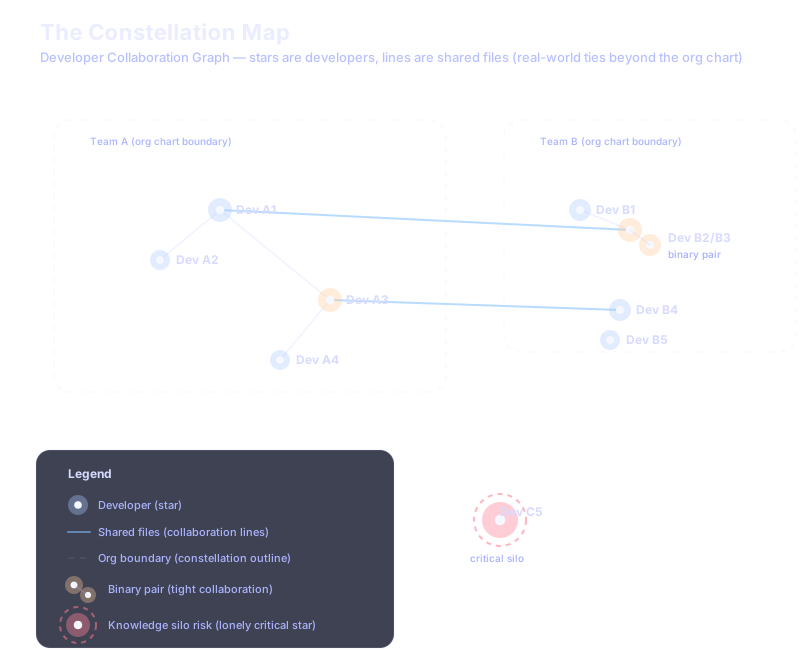
Developer collaboration, as reflected in Git history, reveals how teams actually operate in practice. This often differs from the official organizational chart. It can also expose knowledge silos, where critical parts of the codebase are touched by only a single developer.
When multiple developers frequently commit to the same files, it indicates a need for strong communication to avoid conflicts and ensure smooth integration of changes. By understanding these collaboration dynamics, teams can improve coordination, redistribute knowledge, and align their workflows more effectively with the actual codebase interactions.
Cosmic Analogy
Your organization is a galaxy where developers are stars and collaboration is gravity. Organizational charts draw constellation boundaries, but shared files create gravitational lines that pull developers together across those artificial borders. Some stars form binary pairs orbiting the same code, while others drift in isolation with critical knowledge locked away.
Git history reveals the actual gravity connecting your team. The brightest isolated star is a knowledge silo risk silently waiting to go supernova.
Cosmic analogy
How to Fix
Team Structure & Organization
- Align team boundaries with actual code collaboration patterns revealed by the graph.
- Use collaboration clusters to inform team reorganizations that match real communication needs.
- Use the graph to identify natural sub-teams within larger teams for better autonomy and accountability.
Knowledge Sharing & Ownership
- Identify knowledge silos where single developers own critical code and implement pair programming or knowledge sharing.
- Create shared ownership for highly collaborative files through mob programming or rotation schedules.
Communication & Coordination
- Set up regular sync meetings for developers who frequently touch the same files but sit on different teams.
- Address communication gaps by co-locating developers who work on the same code but lack a formal connection.
Architecture & Code Structure
- Break apart files with high cross-team coupling to reduce coordination overhead and merge conflicts.
- Refactor architecture to better align with Conway's Law. I mean, let teams own complete features or services end-to-end.
Ongoing Monitoring
- Monitor collaboration patterns over time to detect when teams are drifting apart or becoming too coupled.
Does this actually work?
I've been running this analysis against real repositories in Code Evolution, a personal side project, to see whether the idea actually makes sense in practice. It's still rough and unfinished, and for now it only uses a demo repository, but you can already check it out. I'm planning to open-source it soon.
See this one running