 Code Behavior Analysis
Combine Behavior + Complexity
Find true high-risk zones in your code
Behavior + Complexity
I love the movie The Perfect Storm. The scene when a massive wave crashes onto a fishing boat always sticks with me. I suspect some of your files look a lot like that boat; at least, some of mine certainly have. These files usually have many lines of code, lots of ifs, and a lack of tests, and can bring your production down at any time.
I remember one project in particular where we had a moderately complex computation function that was changed very often. It involved a mix of services and a shared, scoped(!!) Entity Framework context. Each class mutated the context's internal state, and those changes cascaded through multiple layers. The result was that customers reported seemingly random bugs that were nearly impossible to reproduce as it depended on the precious state of the context at that moment.
Don't get me wrong, it wasn't a race condition, but it almost behaved like one. The UI was many tabs and the users can change various numbers and options in any order, and that would change the context's state in unpredictable ways. Every time we tried to fix one bug, two more would appear.
To identify these annoying parts of your code, you can use a combination of behavior and complexity analysis.
Why it matters
Combining cyclomatic complexity with change frequency reveals your codebase's danger zones. Complex code isn't necessarily bad if it rarely changes.
Frequently changed code isn't a problem if it's simple.
But when you find files that are both complex AND frequently modified, you've found technical debt that could actively damage your quality of sleep.
By plotting complexity against change frequency, you can visualize exactly which files deserve immediate refactoring attention versus which can safely be left alone.
Cosmic Analogy
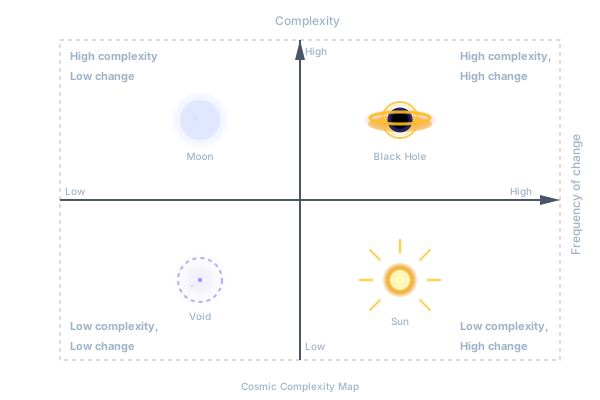
Your codebase can be seen as a cosmic landscape plotted by complexity (vertical) and change frequency (horizontal):
Complex but rarely touched. Legacy code or stable algorithms that simply work. Monitor them, but they're not your immediate threat.
The event horizon. Complex AND constantly changing, sucking in developer time and generating bugs. These are the danger zones demanding immediate refactoring.
Simple and stable. Config files, constants, utilities. Vast, predictable, requiring little attention. Ideal code, if you ask me.
Frequently changing but simple. UI components, API endpoints, feature flags. Their simplicity makes frequent changes safe. Healthy, adaptive code.
Cosmic analogy
How to Fix
Prioritization
- Start with the worst offenders: focus on files in the high complexity + high change quadrant first.
- Schedule regular refactoring sessions focused on hotspot files identified by this analysis.
Code Simplification
- Break down complex functions into smaller, single-responsibility methods that are easier to test and modify.
- Extract business logic into separate classes or modules to reduce cyclomatic complexity.
- Consider splitting large files into multiple smaller files with clear boundaries and responsibilities.
- Use design patterns (Strategy, Factory, Command) to eliminate nested conditionals and switch statements.
Testing & Refactoring Safety
- Add comprehensive unit tests before refactoring to ensure you don't break existing behavior.
- Introduce interfaces and dependency injection to reduce coupling and make code more testable.
Prevention & Governance
- Set up code complexity gates in CI/CD to prevent new complex code from being merged.
- Document architectural decisions and create clear module boundaries to prevent complexity creep.
Does this actually work?
I've been running this analysis against real repositories in Code Evolution, a personal side project, to see whether the idea actually makes sense in practice. It's still rough and unfinished, and for now it only uses a demo repository, but you can already check it out. I'm planning to open-source it soon.
See this one running